

Choosing EV coolant starts with the cooling system—not the color of the fluid or the temperature printed on the container.
For importers, distributors and automotive brands, a suitable product must match the vehicle’s technical requirements, the intended cooling circuit and the conditions in which it will operate. Climate matters, but it cannot replace application confirmation.
Why Coolant Color Is Not Enough
Red and green may help identify products within a particular range, but color alone does not establish coolant chemistry, performance or suitability. Two similarly colored fluids should not automatically be treated as interchangeable. BASF’s technical guidance specifically warns against identifying coolant properties by color alone.
Before selecting a product, confirm its exact reference, formulation and required vehicle specification. Treat color as a secondary identifier—not as the basis for a compatibility decision.
Start with the Cooling Circuit and Formulation
An “EV coolant” description is not enough to confirm where a fluid can be used. Identify the intended circuit: battery thermal management, power electronics, electric motor cooling or another vehicle-specific system.
Ask the vehicle or system manufacturer to confirm the following requirements. Do not assume that a product described as “recommended for” an application has an official vehicle-manufacturer approval. These are different claims and require different supporting evidence.
- The required coolant specification and any approval requirements.
- The permitted base fluid and corrosion-inhibitor chemistry.
- Compatibility requirements for metals, seals, hoses and other wetted components.
- Any electrical-conductivity limits.
- Whether the task involves initial filling, replacement or topping up an existing fluid.
Match Climate Conditions to Documented Performance
Provide the expected temperature range for the destination market, including seasonal extremes and storage or transport conditions—not only the annual average.
For variants named -40°C Red, -40°C Green or -50°C US Version, request the matching product reference and technical data sheet before ordering.
A temperature designation must be checked against the documented test method and concentration. It should not be interpreted as a complete vehicle operating-temperature range. Likewise, “US Version” is not, by itself, evidence of regulatory compliance or vehicle-manufacturer approval.
| Use scenario | Information to check | Buyer’s next step |
|---|---|---|
| Cold regions | Local winter conditions and documented protection for the exact product and concentration. | Share the country, expected cold conditions and vehicle details; review the matching product document. |
| Hot regions | Cooling-system requirements, duty and documented operating limits—not just a colder label. | Describe the location and use; identify the cooling circuit with the service specialist. |
| Multi-market sourcing | Vehicle/system requirements and climate in each destination. | List destinations and applications separately before grouping the order. |
| Topping up | Identity of the existing coolant and the vehicle’s service instructions. | Send a label photo or service record; do not infer a mixing rule from color. |
| Existing product unknown | Available vehicle, circuit and maintenance records. | Begin with photographs or service information; resolve fluid identity before use. |
Choose the Correct Concentration and Packaging
During technical review, establish whether the selected product is a ready-to-use premix or a concentrate. Neither attribute is established here for a FluidVanta product.
A ready-to-use product should be used according to its instructions. A concentrate requires the specified dilution ratio and water quality. Do not apply one universal mixing ratio across all EV coolant products. Manufacturer guidance distinguishes premixed products from concentrates and specifies dilution requirements for each.
Packaging should make the selected formulation and temperature variant easy to identify. Confirm carton quantities for the exact product rather than assuming every coolant uses the same pack format.
- Confirm the supplied concentration and whether further dilution is permitted.
- Specify net contents per container, clearly stated by mass or volume.
- Confirm containers per carton and the required whole-carton order quantity.
- Confirm label language, product reference and batch identification.
- State standard-brand or private-label packaging requirements.
Do Not Assume Suitability for Direct-Contact or Immersion Cooling
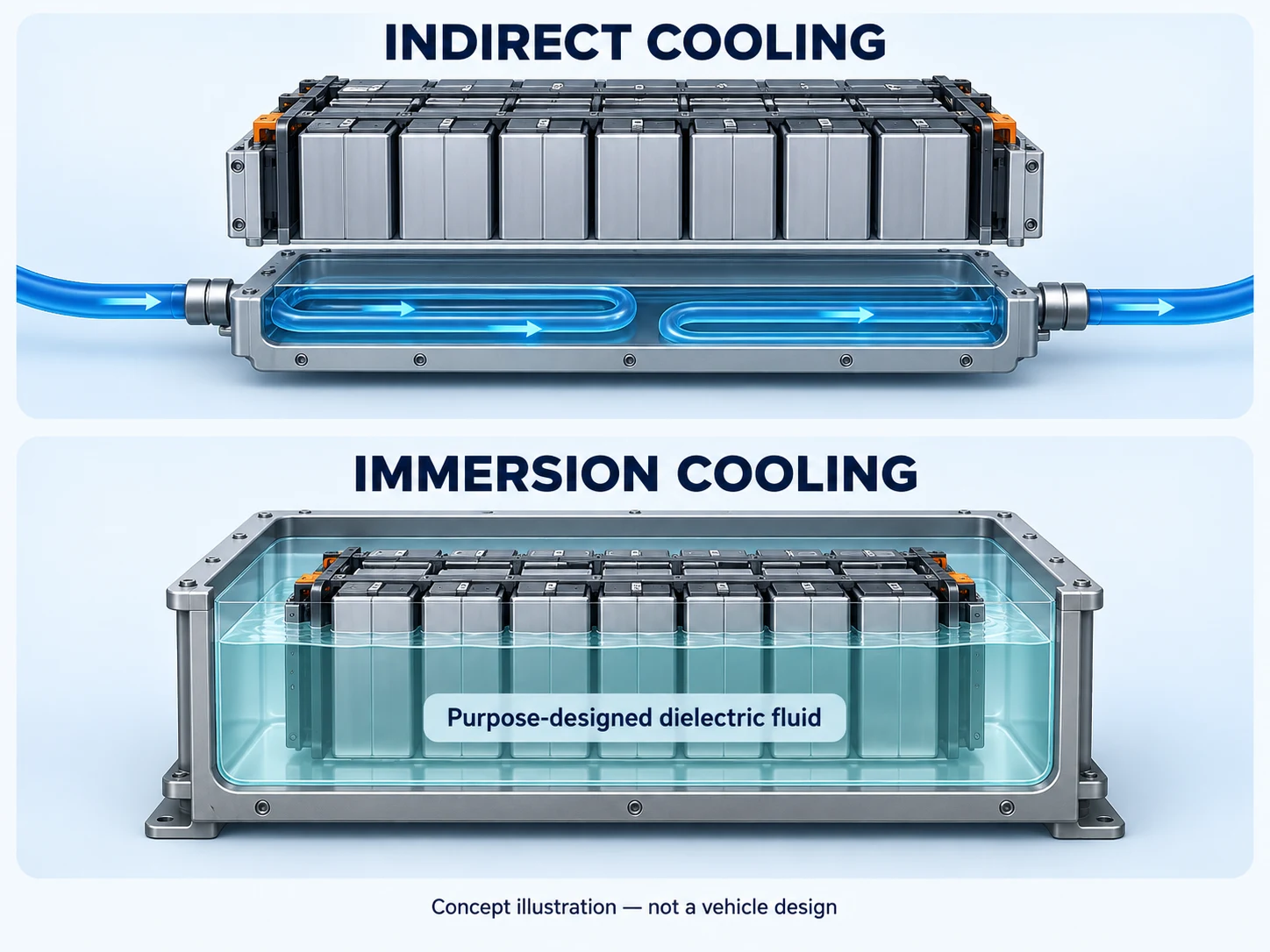
An EV coolant must not be assumed suitable for direct contact with battery cells, energized components or immersion-cooling systems.
Direct cooling requires purpose-designed dielectric thermal-management fluids and system-specific validation. A fluid intended for an indirect cooling circuit is not automatically a substitute.
Require system-specific evidence for any direct-contact or immersion application. The illustration and external reference explain general systems, not confirmed FluidVanta product performance.
How to Request TDS and SDS Documents
Request available documents for the exact product reference. Ask which TDS, SDS or test information can be supplied; do not assume a complete document set exists for every product.
Include the product reference, temperature variant and destination country in your request. Ask for the applicable document revision and language.
Neither a TDS nor an SDS should be treated as automatic proof of vehicle approval. If an approval is required, request separate supporting evidence.
- Technical Data Sheet (TDS): review the stated properties, concentration, temperature data, intended applications and limitations.
- Safety Data Sheet (SDS): review handling, storage, hazards and disposal guidance.
First Inquiry: Start with the Information You Have
Share your vehicle model, model year and intended application so we can review the appropriate product reference. You do not need every technical parameter to begin.
If the existing coolant is unknown, send a label photo, cooling-system information or a service record. Color, climate and a freezing-temperature designation do not by themselves establish vehicle suitability.
- Vehicle model and model year.
- Destination country and expected climate.
- Topping up or replacing the coolant.
- Existing product photos or available service/system information.
- Estimated quantity and standard-pack or private-label preference.
Follow-up Technical Review
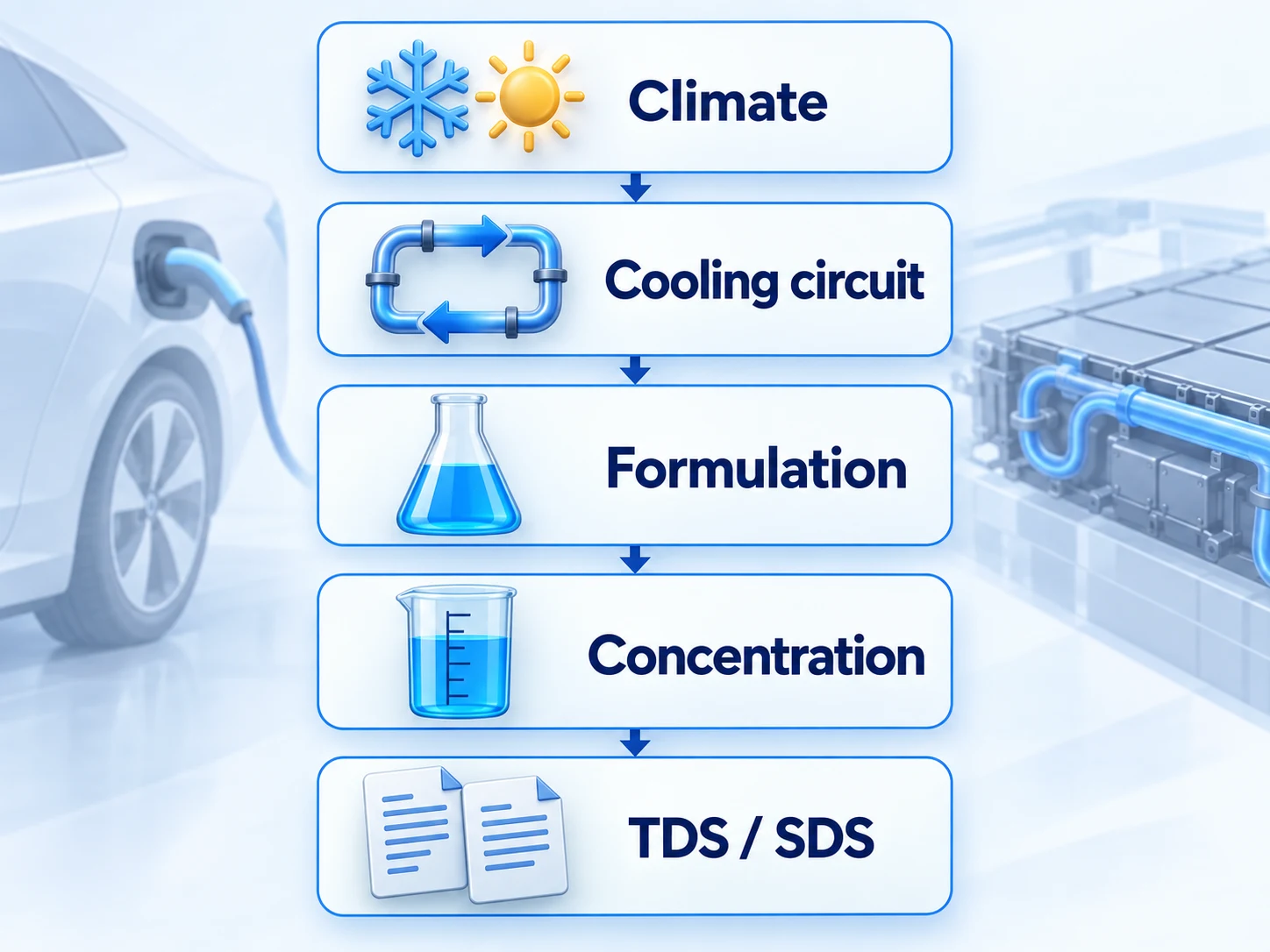
After the first inquiry, identify the exact cooling circuit and service requirement with the responsible technical person. Review the selected product’s documents for formulation, concentration, temperature data and use limitations. Do not infer these properties from the product name, color or pack size.
Existing Coolant References and Packaging
These are application references for discussion, not vehicle approvals. Packaging is shown from the shared product records.
| Product reference | Unit packaging | Carton quantity |
|---|---|---|
| EV Coolant for Tesla Applications | 4 kg / container | 4 containers / carton |
| EV Coolant for GAC Aion Applications | 4 kg / container | 6 containers / carton |